
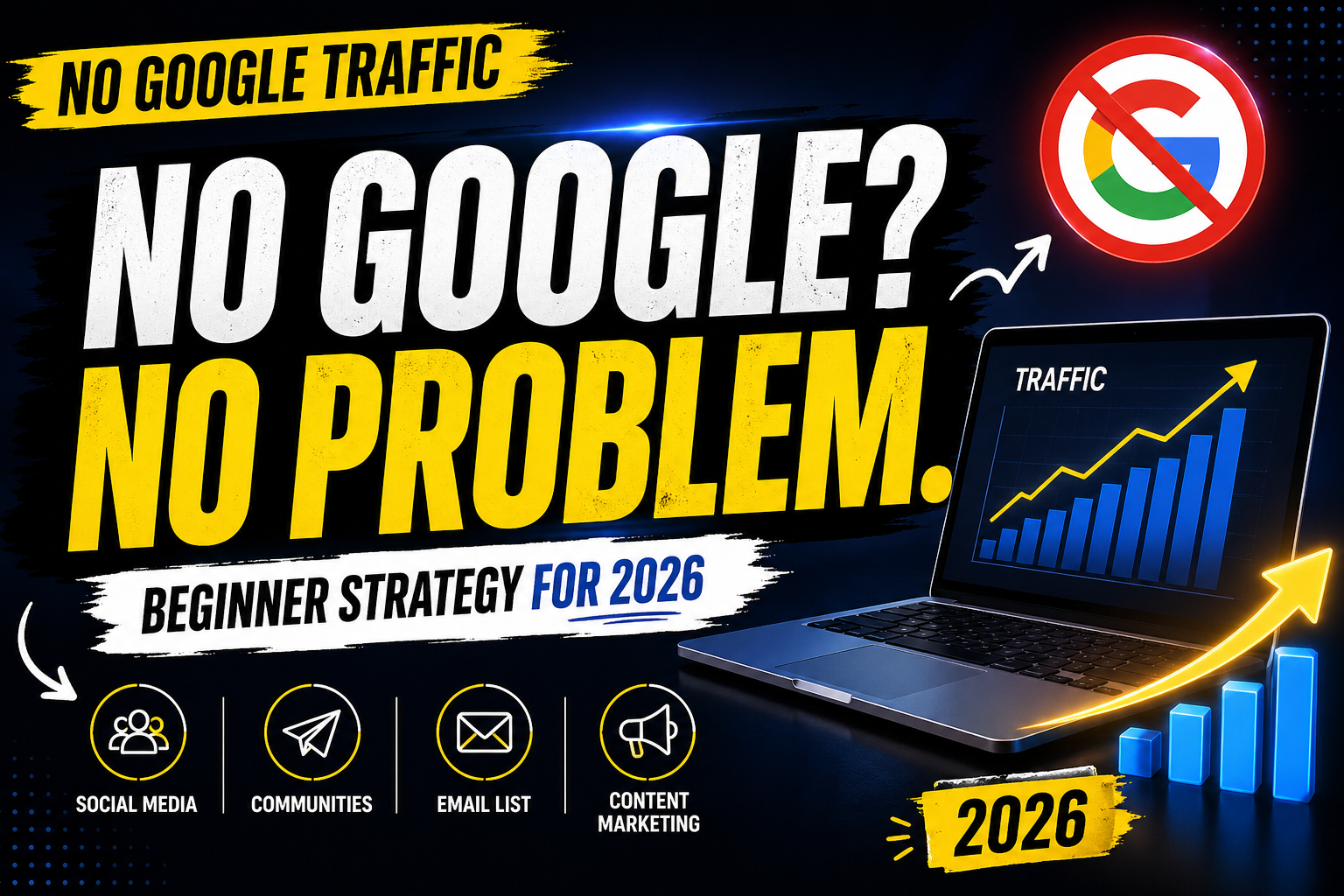
Introduction: You Don’t Need Google to Get Traffic
Let me tell you something most beginners don’t realize at the beginning. You can get traffic without Google and there are various methods to achieve traffic without Google. I know it sounds weird, because anywhere you look, everybody is talking about SEO, rankings, and how to get on #1 page. The truth is, you can still gain valuable traffic without Google.
So naturally, you start thinking that’s the only way to grow your blog. But here’s the reality most people forget to realise: When your blog is new, Google doesn’t even know your site exists yet.
You may post great content, be consistent with your writing work, even do proper keyword research, like I explained in How to Do Keyword Research In 2026: A Complete Beginner’s Guide, and still see zero traffic.
To illustrate, platforms like social media and online communities are great for generating traffic without Google. They allow you to connect with your audience directly and share your insights.
Not because your content is bad. But because you’re relying on a system that takes time to build trust with new sites. So, instead of waiting for Google to “Maybe” send you traffic someday, there’s a smarter way to get started.
It’s crucial to understand that the reliance on Google can limit your exposure. By diversifying your traffic sources, you can achieve substantial growth and traffic without Google.
Consider this: many successful creators have thrived on platforms outside of Google, proving that traffic without Google is not only possible but also effective. You just need to find your audience.
Why Relying Only on Google Is a Mistake
No doubt. Google traffic is powerful.
When you explore avenues for traffic without Google, you open doors to new opportunities that traditional SEO cannot provide. Think beyond search engines to reach your audience effectively.
But depending on it completely, especially in the just beginning, is one of the biggest mistakes you can make. Here’s why:
- SEO Takes Time
It can take weeks or even months before you see any good or real results, even if you do everything right.
- It’s Unpredictable
You might publish a great article, but it doesn’t get ranked. Meanwhile, something average ranks higher. That’s just how the game works.
- It’s Not About The Source Of Traffic Only
As I talked about in GEO Is The Future Of Search: Why SEO Alone Won’t Be Enough in 2026, search is evolving. People are discovering content through platforms, communities, and recommendations, not just Google.
So, if your only focus is on getting ranked, you’re limiting your growth without even realising it.
As you navigate the blogging landscape, keep in mind that securing traffic without Google may require creativity and perseverance, but it’s entirely feasible.
The Real Goal: Get Your First Traffic From Anywhere
At the beginning, your goal shouldn’t be “rank #1 on Google.” Your goal should be much simpler: Get your first visitors, from anyhow, and from anywhere.
It doesn’t matter if they come from:
- Online communities
- Direct sharing
- Social media
Or by any other content platforms, what matters here is whether people are engaging with your content or not. Because once people start to engage with your content.
- You get feedback
- You build confidence
- You understand what works and what not
- And your blog starts to feel real
Most of the blogs fail not because they lack strategy, and quality content, but because they never get that initial traction, something I’ve already broken down in my article Why Do Most Blogs Fail (And How You Can Avoid It?).
So stop waiting for Google to notice your blog. Start gaining attention wherever you can by whatever means possible (Don’t try something illegal). Because traffic doesn’t come from any place, it comes from people.
Strategy #1: Use Social Platforms to Distribute Your Content
Right now, you’re just a beginner with no traffic. But platforms already do. So instead of waiting for people to find your blog, you go where people are already spending time.
Platforms like:
- X(Twitter)
- Threads
- Instagram(Even Instagram can help you distribute content, if used smartly)
These are not just for posting random thoughts. They’re distribution engines.
Here’s what most people do wrong: They write a blog.. Publish it..
And then do nothing.
No one sees it.
Instead you should:
- Turn your blog idea into short posts
- Share insights, not links first
- Build Curiosity
For example, if you wrote a blog on building backlinks, you can post:
“Everyone says build backlinks. But no one tells you this..”
Then later, you plug your blog like:
Forget Backlinks: Do This Instead To Rank Faster In 2026
That’s how you can bring people in. Don’t think of social media as optional. Think of it as your first traffic source.
Strategy #2: Turn One Blog Into Multiple Pieces of Content
If you’re writing one blog post and posting it once, you’re wasting its potential.
One blog = Multiple content opportunities. Let’s say you wrote an article on blogging or SEO. You can turn it into:
- 2-3 linkedin posts
- A simple carousel idea
- Even a discussion topic
- 5-10 short posts(X/Threads)
Same idea, different formats. You don’t need more content.
You need more distribution of that same content.
For example: My blog on Topical Authority Explained: How To Rank #1 Without Backlinks (2026 Guide) can become:
- A post breaking one key mistake
- A hook based short post
- A thread explaining topical authority
This is how small creators grow faster, they don’t just create things, they repurpose them smartly.
Strategy #3: Post Where Your Audience Already Exists
You don’t need to build an audience from scratch everywhere. There are already places where your audience is active. You just need to show up there. Think about:
- Quora
- Medium
- Comment sections on related content
- Reddit communities
- Niche forums
People are already asking questions like:
It’s not just about visibility, it’s about understanding that traffic without Google can lead to meaningful engagement with your content.
“Why is my blog not getting traffic”
“How do I start SEO”
And you already have answers, because you have written about them. For example, if someone asks why their blog is not growing, you can share insights from: Why Do Most Blogs Fail (And How You Can Avoid It?).
Or if they are confused about SEO basics, you can guide them using: How to Do Keyword Research In 2026: A Complete Beginner’s Guide
You’re not spamming links. You’re adding value, and your blog becomes a deeper resource.
That’s the shift. Instead of waiting for traffic to come to you, you go where the attention already is, and bring it back to your blog.
Strategy #4: Use Medium and Other Platforms for Extra Reach
Right now, you’re just getting started and your blog is brand new. Which means, low authority, low visibility. But platforms like Medium already have:
- Built-in traffic
- Distribution systems
- Active readers
So instead of relying only on your own site, you can borrow their audience.
You can:
- Write shorter versions with a link back
- Republish your blog(with a bit of editing)
For example, you can repurpose: Forget Backlinks: Do This Instead To Rank Faster In 2026 into a shorter Medium article and redirect readers to your main blog.
Same with: Topical Authority Explained: How To Rank #1 Without Backlinks (2026 Guide)
This gives your content a second life.
Ultimately, your focus should be on generating traffic without Google through various channels, which can result in a loyal readership and increased visibility.
Because now: It’s not just sitting on your site, it’s also about being actively discovered elsewhere. Don’t think “duplicate content problem.” Think: More entry points to your blog.
Strategy #5: Build in Public and Share Your Journey
People don’t just follow content. They follow progress. And right now, you have something powerful most big creators don’t, you’re still young and early in this game.
Which means:
- You can share what you are learning
- Show real growth
- Share what’s working and what’s not
For example:
- I published 5 blogs but got 0 traffic, here’s what I learned
- Trying to grow my blog from 0, day 7 update
This makes your content relatable. Because instead of acting like an expert who knows everything. You’re showing someone who’s figuring things out in real time.
And that builds trust much faster than anything else.
Strategy #6: Focus on Clickable Titles and Hooks
You can have the best content in the whole world. But if no one clicks, it doesn’t matter. This is where most of the beginners struggle.
They write titles that are: Too generic, too unclear, or too boring.
Instead of : “SEO Tips For Beginners”
Write: “Why Your SEO Isn’t Working (And How To Fix It)
See the difference?
Your title should:
- Highlight a problem
- Create curiosity
- Promise a clear outcome
Because people don’t click on “information.”
They click on interest.
Strategy #7: Stay Consistent With Distribution
Most people are not consistent with writing. They’re inconsistent with sharing. They publish a blog, post it once, and then move on. That’s the mistake.
Distribution isn’t a one time thing. It’s something you keep doing, and keep on repeating.
For every blog you write:
- Post about it on social media multiple times
- Share different angles about it
- Reuse it across platforms
You don’t need new content every day. You need more visibility for the content you already have.
This is especially important for beginners. Because as we talked about in Why Do Most Blogs Fail? (And How Can You Avoid It?) Most people don’t fail due to lack of effort, they fail due to lack of consistency and strategy.
So don’t just focus on publishing. Focus on making sure your content is actually seen by people. Because at the end of the day: Content grows when it’s distributed, not when it’s just written.
How Long Does It Take to See Results?
This is the part most people are impatient about. You start posting, sharing your content, trying different platforms… and then you expect results in a few days. It doesn’t work like that.
In the beginning, you might get:
- Inconsistent views
- Very low traffic
- Or sometimes nothing at all
And that’s normal.
Because you’re still learning:
- Where your audience comes from
- How to present your content
- What works and what not
But if you stayed consistent with distribution, you can start seeing:
- Small spikes from certain platforms
- Gradual growth over time
- Your first clicks within days or weeks
It won’t be instant, but it’s much better, and faster than waiting for SEO alone. The key is to not stop after 2-3 posts. Because most people quit right before things start to work.
When Should You Start Focusing on SEO?
Here’s the smart way to think about it: You don’t ignore SEO, you just don’t have to depend on it at the beginning.
In the early stage of blogging you should focus on:
- Getting attention
- Understanding your audience
- Building content
And, once you have:
Traffic Without Google: 7 Proven Ways to Grow Your Blog (2026)Your commitment to seeking out traffic without Google will set you apart and help you build a robust online presence.
- 10-20 quality blog posts
- A bit of traffic from other sources
- Some idea of what works
That’s when SEO starts to become powerful.
Because now:
Remember, the goal is to generate traffic without Google through innovative strategies and by leveraging various platforms where your audience resides.
- Your content has depth
- Your site has structure
- And Google can actually understand what your blog is about
If you have already worked on your basics like proper keyword research, you’re already ahead of most people. Now it’s not about choosing between SEO and distribution, it’s about combining both of them.
Conclusion: Traffic Comes From Distribution, Not Just Rankings
At this point, it should be clear for you: Traffic doesn’t come from just publishing blogs and waiting. Traffic comes from getting your content in front of the audience.
Most people make this mistake: They focus only on writing, and completely ignore the distribution part. But the blogs that actually grow are the ones that:
- Show up consistently
- Share their content
- And use multiple platforms
SEO is powerful, no doubt about it. But it’s not the only way anymore. The way people discover content is changing. They are not just relying on search engines alone, they are finding content through different platforms, creators, and communities.
So instead of waiting for rankings, start taking action. Distribute your content. Experiment with platforms. Pay attention to what works and what not.
Because at the end of the day: Traffic doesn’t come from google alone, it comes from everywhere you choose to show up.
Bonus Point: 📚 Recommended Reads That Shaped My Thinking
In conclusion, while Google is a powerful tool, it is essential to explore traffic without Google possibilities to ensure that you are diversifying your traffic sources effectively.
About The Author
I’m Kushagra Shukla, a student, builder, and creator passionate about blogging, AI automation, and coding. Through my blog, Peak Persona, I break down marketing, AI, and online growth into clear, practical, and beginner-friendly insights to help creators and businesses think smarter and grow faster.
Alongside blogging, I also run PeakWorks, a web development and digital solutions agency where I help businesses build fast, modern, and high-performing websites with a focus on design, performance, and SEO.
I’m always learning, experimenting, and building with the goal of creating work that delivers real, long-term impact.
If you enjoy my content and want to support my work, you can Buy Me A Coffee Here ☕
Every bit of support helps me keep building, learning, and sharing practical insights.
If you have any work-related questions about websites, digital growth, blogging, or AI automation, you can Book Your Free 1:1 Call Here
For work inquiries, email me at: Kushagra Shukla
Leave a Reply